

Significant energy savings from warm edge spacer bars
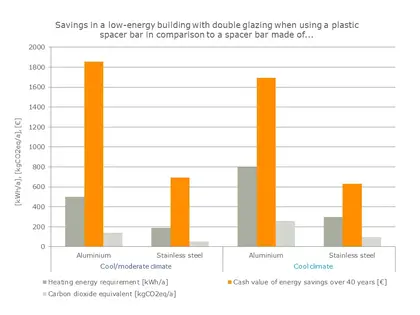
A study conducted by the Passive House Institute provides valuable insights for architects, planners, and builders. The results show that homeowners and tenants in Germany can reduce their annual heating energy demand by 8.6% in a typical modern low‑energy house simply by using highly efficient warm‑edge spacer bars instead of conventional aluminium spacers.
This demonstrates that even a small component can have a substantial impact: the spacer bar plays a crucial role in improving the overall energy efficiency of windows and buildings.
What is a spacer bar and why does it matter for energy savings?
The spacer bar is located at the perimeter of insulated glazing units and maintains the distance between the panes. This cavity is usually filled with an inert gas, such as argon, to enhance thermal insulation.
Spacer bars currently on the market include aluminium, stainless steel, and non‑metallic warm‑edge spacer systems. The study clearly shows that, alongside the glazing and the window frame, the spacer bar represents the third key factor influencing the thermal performance of modern insulating windows.
Lower heating costs with warm edge Lower Heating Costs over the Building’s Lifetime
Compared with aluminium spacers, warm‑edge spacer bars significantly reduce heat losses at the edge of the glass. As a result, occupants benefit from lower heating costs throughout the entire service life of the window.
In the study’s reference case - a low‑energy house in Frankfurt with triple glazing - this translates into savings of €2,463 over 40 years. Although windows equipped with high‑performance warm‑edge spacers have slightly higher upfront costs, the long‑term energy savings clearly outweigh the initial investment.
Improved Thermal Comfort and Reduced Risk of Mold
Warm edge spacer bars contribute to noticeably higher living comfort. Interior surface temperatures at the window edge remain more stable, even during cold winter periods.
In addition, reduced temperature differences at the glass edge significantly lower the risk of condensation and subsequent mold growth. This not only improves indoor health conditions but also enhances the durability, quality, and long‑term value of the building.
Reduced CO₂ Emissions
Lower energy demand leads directly to lower CO₂ emissions. The study highlights that choosing an efficient spacer bar allows building owners to make a surprisingly large contribution to climate protection using a small but highly effective component.
Heat Transfer Coefficient: The Decisive Factor
The thermal performance of a spacer bar is determined largely by its heat transfer properties. If the spacer has a high thermal conductivity, substantial heat losses occur - regardless of high‑quality glazing or frames.
The study compares materials as follows:
- High‑performance warm‑edge spacer: linear thermal conductivity of 0.14 W/(mK)
- Stainless steel spacer: 0.6 W/(mK)
- Aluminium spacer: approximately 160 W/(mK)
These differences clearly illustrate why aluminium spacers perform poorly in energy‑efficient window systems.
More design freedom in window planning
Because less energy is lost through windows with efficient plastic spacers, larger window areas can be realized on the east and west sides of buildings. On the south side, according to the study, they allow "heating energy requirements to drop even to full glazing."
Please note: Although the Passive House Institute study was published several years ago, its core findings remain valid. Subsequent standards, certifications, and market developments confirm that warm‑edge spacer systems significantly reduce thermal bridging at the glazing edge, improve comfort, and lower energy demand compared with aluminium spacers. The exact savings depend on building type and climatic conditions, but the performance advantage is undisputed.
